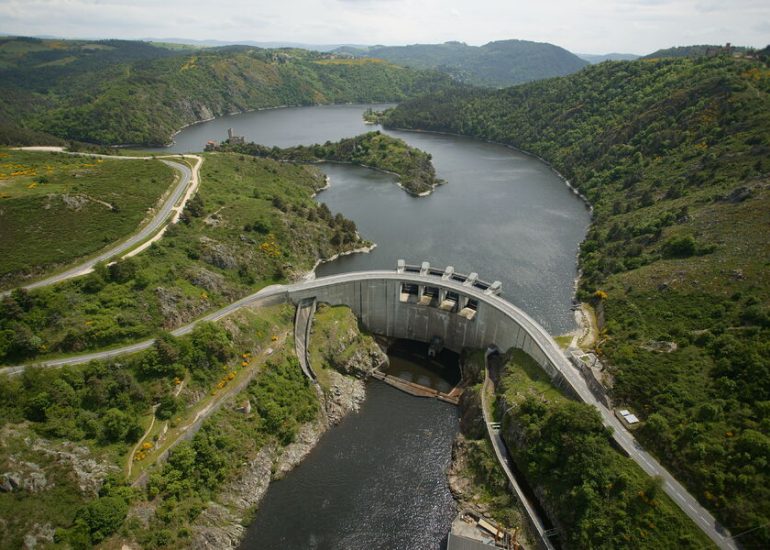
Built between 1955 and 1957 on the Loire river, the Grangent dam is located downstream of Aurec sur Loire (43) and upstream of St Just St Rambert (Loire). It is a concrete dam made of a cylindrical vault, 55m high and 206m long.
Description
Its construction had a significant impact on the landscape. In fact, when the reservoir was filled, part of the valley was submerged. As a result, bridges, houses, and even the Firminy–St. Just railroad line were engulfed by the reservoir.
Its primary function is hydroelectric power generation, but the dam also regulates the river’s flow and provides a road crossing. The artificial reservoir it creates, Lake Grangent, supports recreational boating activities.
Majestic Landscapes
The construction of the Grangent Dam has profoundly altered the landscape of the Loire Gorges. The steep, dark gorges have given way to a luminous body of water that has spurred the growth of tourism. The filling of the reservoir led to the submersion of infrastructure such as the Firminy–Saint-Just railway line, as well as some houses and bridges. Other hamlets, once sheltered from the river’s floods, now lie along the banks of the Loire, offering sumptuous landscapes, such as the Châtelet Peninsula, Les Camaldules, and the island of Grangent Castle.
Changed Ecosystems
With the construction of the dam, the Loire’s flow has decreased. As a result, freshwater fish such as trout and salmon—once enjoyed at the castles of Saint-Victor and Essalois—have given way to species that prefer calm waters (roach, carp, etc.). The reservoir also encourages the arrival of other plant and animal species of ecological interest. This diversity has led to the protection of the Loire Gorges as a classified site, a Natura 2000 site, and the designation of certain parcels as a Regional Nature Reserve.
A “Nature”-Focused Regional Initiative
Today, this magnificent body of water offers spectacular panoramic views, as diverse as they are rich in biodiversity, as well as a remarkable history. It fosters the growth of water sports and tourism in our region, with stakeholders committed to developing sustainable tourism focused on “immersive” experiences!
Technical Specifications of the Dam
The Grangent Dam is an “arch-gravity” dam. It is 200 m long and 55 m high.
Its reservoir, maintained at maximum level between June 1 and September 15 each year, offers tourists a 365-hectare body of water stretching 21 km, holding more than 57 million cubic meters of water.
It is equipped with four gates, each measuring 14 m high and 12 m wide. These gates allow up to 6,000 m³ of water to be discharged per second.
On average, it produces the equivalent of the annual domestic water consumption of a city with 50,000 residents.
Warning
Electricity generation at hydroelectric plants causes significant fluctuations in flow, leading to sudden rises in river water levels. Stay away from the river when the current accelerates and the water level rises. On a lake near a dam, do not venture beyond the buoys. Obey all signs and markings near dams, canals, and rivers.
Opening period
All year round: open every day.